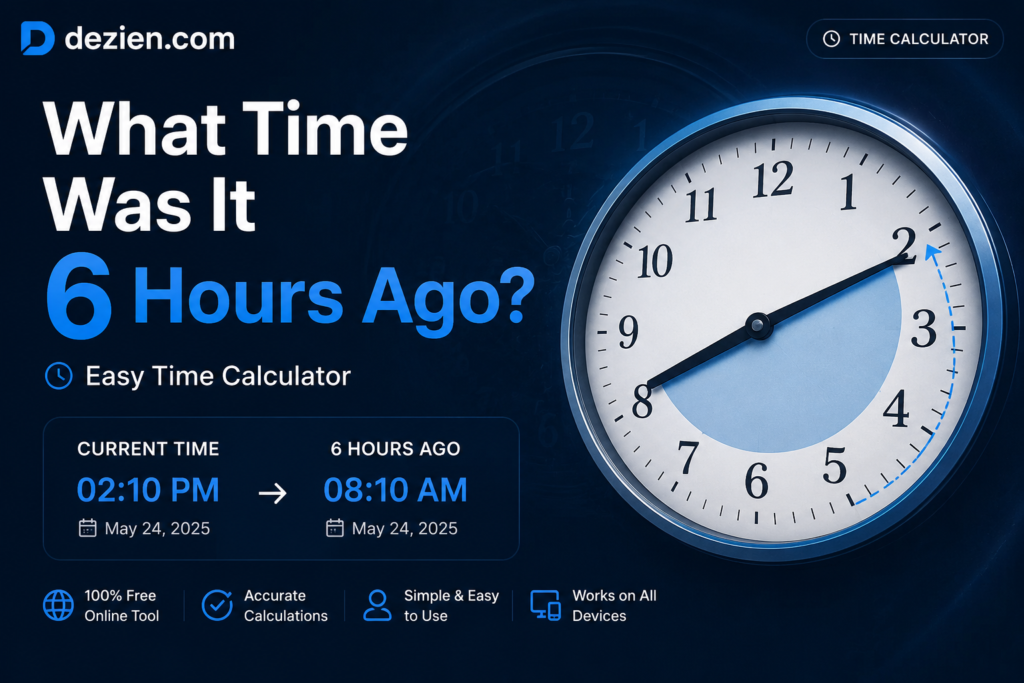
Have you ever looked at the clock and wondered, “What time was it 6 hours ago?” It doesn’t matter if you’re tracking work hours, calculating time differences, reviewing different events, or simply satisfying your curiosity, understanding how to calculate past time is a useful skill.
Calculating time plays an important role in everyday life. Starting from meetings to managing projects, or to planning travel and tracking activities, knowing how to sumarise a previous time can save effort and prevent mistakes.
In this article, we’ll explain how to calculate what time it was 6 hours ago, why this calculation is useful, and some easy methods you can use.
What Does “6 Hours Ago” Mean?
The phrase “6 hours ago” refers to a point in time that occurred exactly six hours before the current moment.
For example:
- If the current time is 6:00 PM, then 6 hours ago was 12:00 PM.
- If the current time is 10:00 AM, then 6 hours ago was 4:00 AM.
- If the current time is 1:00 AM, then 6 hours ago was 7:00 PM on the previous day.
The calculation simply involves the difference of six hours from the current time.
How to Calculate What Time It Was 6 Hours Ago
Calculating a past time is straightforward.
Step 1: Identify the Current Time
First, note the current hour.
Example:
Current Time: 8:00 PM
Step 2: Subtract Six Hours
8:00 PM − 6 Hours = 2:00 PM
Therefore, 6 hours ago it was 2:00 PM.
Step 3: Adjust the Date if Necessary
If calculation of six hours moves you into the previous day, remember to adjust the date.
Example:
Current Time: 4:00 AM
4:00 AM − 6 Hours = 10:00 PM (Previous Day)
This is especially important when recording events or working across different time zones.
Examples of Time Calculations
Here are some quick examples:
| Current Time | 6 Hours Ago |
| 12:00 PM | 6:00 AM |
| 3:00 PM | 9:00 AM |
| 6:00 PM | 12:00 PM |
| 9:00 PM | 3:00 PM |
| 12:00 AM | 6:00 PM (Previous Day) |
| 4:00 AM | 10:00 PM (Previous Day) |
These examples show how simple it is to determine a previous time by subtracting six hours.
Why People Search “What Time Was It 6 Hours Ago?”
There are many reasons why people need to calculate a time six hours earlier.
1. Work and Productivity Tracking
Employees and freelancers often need to be punctual when they start a task or shift.
For example, if a shift ended at 8:00 PM and lasted six hours, it started at 2:00 PM.
2. Travel Planning
Travelers frequently calculate past times when checking flight schedules, layovers, and international departures.
3. Event Analysis
News reporters, researchers, and analysts may need to identify exactly when an event occurred relative to the current time.
4. Medical and Health Tracking
Doctors and patients sometimes calculate medication schedules.
For example, if medicine is taken every six hours, knowing the previous dose time is important.
5. Personal Time Management
Many people simply want to know when they performed an activity earlier in the day.
Easy Mental Method for Calculating 6 Hours Ago
A quick mental trick is to count the previous six numbers on the clock.
For example:
Current Time: 7 PM
Count backward:
- 6 PM
- 5 PM
- 4 PM
- 3 PM
- 2 PM
- 1 PM
Answer: 1 PM
This method works well for quick calculations without a calculator or smartphone.
Using Digital Devices to Find Past Time
Modern devices make time calculations simple.
Smartphones
Most smartphone clock applications allow you to determine previous times quickly and friendly.
Online Time Calculators
Many websites provide time calculators where you enter the current time and get your desired time calculator according to your desire.
Virtual Assistants
Digital assistants can answer questions such as:
“What time was it 6 hours ago?”
and provide an immediate result based on your current location and time zone.
Also Read: https://dezien.com/what-time-was-it-9-hours-ago/
Understanding Time Zones
When calculating time six hours earlier, time zones can sometimes create confusion.
For example:
- A person in New York may have a different current time than someone in London.
- Calculating six hours must always be based on the local time you are using.
When dealing with international communication, always verify the time zone before performing calculations.
Common Mistakes When Calculating Past Time
Forgetting Date Changes
A common error occurs when calculating hours crosses midnight.
Example:
Current Time: 2:00 AM
2:00 AM − 6 Hours = 8:00 PM (Previous Day)
Many people forget to change the date.
Mixing AM and PM
Another frequent mistake is confusing morning and evening times.
Double-check whether the result should be AM or PM.
Ignoring Time Zones
When communicating globally, always consider local time differences.
Benefits of Learning Time Calculations
Understanding time calculations provides several advantages:
- Improved scheduling
- Better productivity
- Accurate event tracking
- Easier travel planning
- Enhanced time management
The ability to quickly determine previous times is useful both personally and professionally.
Conclusion
The answer to “What time was it 6 hours ago?” depends entirely on the current time. The calculation is simple: minus six hours from the present time and adjust the date if necessary.
Whether you’re managing work schedules, planning travel, tracking medication, or analyzing events, knowing how to calculate past time can be extremely valuable. With a little practice, determining what time it was 6 hours ago becomes quick and effortless.
By understanding basic time calculations, you can improve your daily routine and make more informed decisions based on accurate timing information.