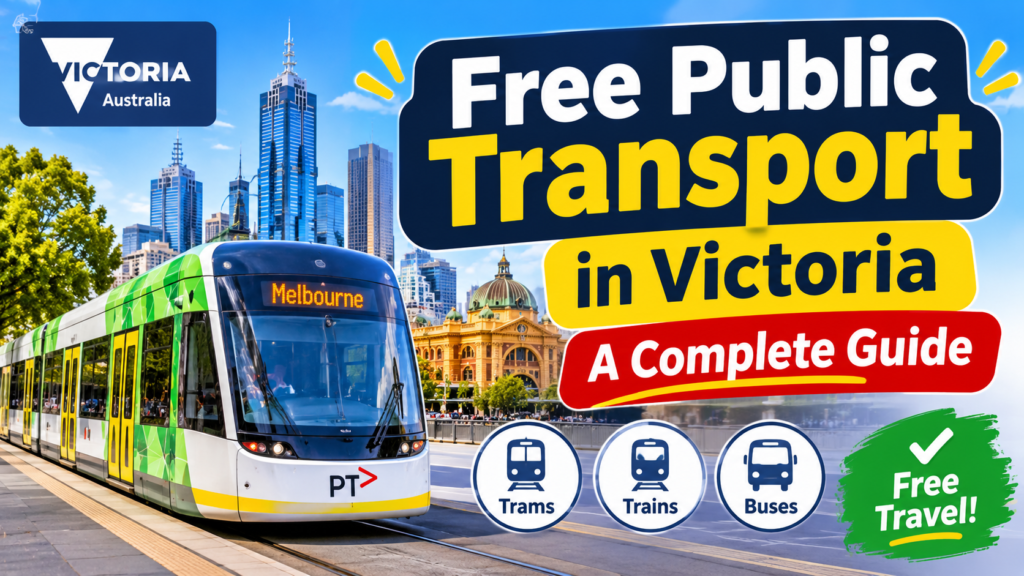
When you ask ten Melburnians what Victoria free public transport means then you will have ten different answers. Maybe one answer is the CBD tram zone. While others will tell you the free April of 2026. If there is any parent, they will talk about a youth card. All answers are right, because Victoria offers multiple separate free-travel schemes at once, each with its own rules.
In this guide, you will know the difference so you can work out which suits you more.
The Permanent Free Options
The Free Tram Zone and City Circle
The oldest scheme is the Free Tram Zone across Melbourne’s central city. Through this, you do not need to tap off or on, or even you do not need a myki at all. The rule is simple: if your journey starts or ends outside the zone, you need a valid myki for the whole trip. People often get caught outside the zone, so check your stop first then proceed.
On the other side, the City Circle tram is also free. Its heritage W-class trams loop the CBD about every 12 minutes, roughly between 9.30am and 5pm, and a full round takes around an hour. They are slow, charming and not wheelchair accessible, so treat them as touring.
Under-18s and the Youth myki
Since 1 January 2026, individuals under 18 can travel free on buses, trains, trams and regional coaches across the state. The state’s Government called it as cost-of-living relief, pointing to the $755 a year that a student pass used to cost.
The details matter here:
- Travel free and need no card for the children aged four and under.
- From five to 17 need a Youth myki, which costs $5 online or at staffed stations.
- The card works like any other myki, so you still tap on and off.
- It stays valid until the holder turns 18, and 18-year-olds move to concession fares.
Here, sometimes parents assume a child can travel free without the card. But actually they cannot.
Carers, Seniors and Disability Support Pension holders
Free weekend travel is another big permanent scheme. Seniors, carers and recipients of the Disability Support Pension can ride free on weekends with a valid myki. The fine print varies by card. According to the state’s ticketing guide, some card holders get weekend travel within two consecutive zones, so a long weekend trip around multiple zones may still be charged. Just need to read the conditions for your specific card before having a trip.
Pensioners, veterans, seniors and carers can also apply for free travel vouchers, and eligible people may qualify for a free travel pass. Veterans and war widows have additional free days around Anzac Day and Remembrance Day.
What Happened in 2026
This year gave Victorians a rare experiment. Public transport was free for everyone through April and May, introduced as a short-term response to fuel pressure. The government then extended it to the end of May and moved to half-price fares from 1 June.
Under the half-price arrangement, the daily fare cap fell from $11.40 to $5.70 across trains, trams and buses. The measure was funded at $432 million, and the government described it as temporary from the start.
That matters right now. At the time of writing, in early November, the half-price period is scheduled to run until the end of December. If you commute daily, check the official fare page before 1 January, because the cap is expected to return to its normal level unless the government announces otherwise.
Does Free Travel Actually Change Behaviour?
Research from elsewhere offers a clue. A randomised trial in Santiago, Chile, found that fare-free access increased overall travel by 12 per cent, with off-peak trips rising by 23 per cent. Those people did not necessarily swap cars for trains. Some simply travelled more.
Free fares remove a cost, but they do not fix crowding, reliability or distance. A tram that arrives every twenty minutes is not made better by a zero fare. Victoria’s current mix, with targeted free travel for young people and older people and temporary relief for everyone else, reflects that trade-off.
Using the Public Transport Victoria Timetable Properly
Free travel is only useful if the service is available when you need it. The public transport Victoria timetable is available through the Journey Planner on the official website and through the PTV app. You can also phone 1800 800 007.
A few habits make the tools far more useful:
- Search by address or landmark, not only by stop name. The planner will suggest the nearest stop.
- Check the day type. Weekend and public holiday timetables often differ sharply from weekday ones.
- Look at disruptions before leaving. Trackwork can replace trains with buses, and the planner shows these changes in real time.
- Use the planner to calculate a concession fare if you are not sure what you will pay.
For regional trips, remember that V/Line coaches and trains are covered by the under-18 scheme, so a teenager travelling to a country town does not pay either.
Common Mistakes Worth Avoiding
Assuming free means no card. Outside the Free Tram Zone, almost everyone still taps a myki, including under-18s.
Using the wrong concession. The state warns that people who ignore eligibility rules can be fined. A concession myki costs $3, and you can hold it alongside a free travel pass.
Forgetting visitors. Reports suggest the Youth myki is intended for Victorian residents, so interstate or overseas teenagers should confirm their position before relying on free fares.
Relying on old information. Many guides still describe April’s free period as ongoing. It ended on 31 May.
The Bigger Picture
Victoria has progressively built a layered system. Few free travel is geographic, like the tram zone. While some are based on circumstance or age. And some are temporary and tied to economic conditions. So, that layering makes the system perfect, but little confusing.
The practical advice is work out which category you really fall into, pick the right card, and learn the rules against the official transport website rather than a blog post, including this one. Policies here change quickly, and the half-price scheme is a good example.