More Than the Man Who Designed St Paul’s
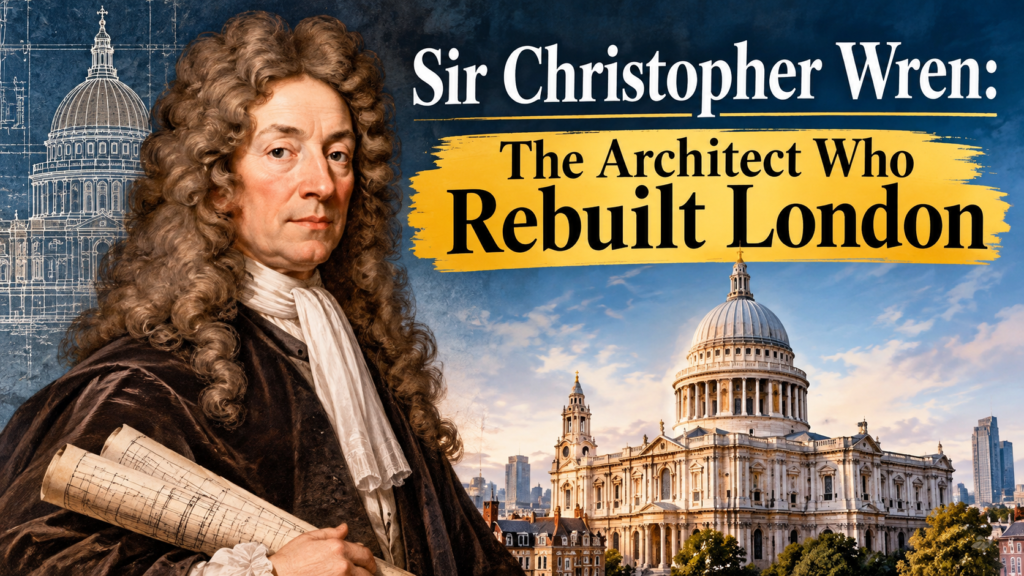
The name architect Sir Christopher Wren is directly linked with the dome of St Paul’s Cathedral. His contribution goes beyond one building: he deliberately helped rebuild London and brought scientific thinking to architecture.
From Scientific Study to Architecture
Born in East Knoyle, Wiltshire, in 1632, Wren studied at Wadham College, Oxford. He was Interested in mathematics, mechanics, astronomy, and anatomy. After this he became professor of astronomy at Gresham College and after that he held the Savilian professorship at Oxford.
Wren was also part of the Royal Society’s circle, established in 1660, a number committed to observation, experiment and the swap of knowledge. His knowledge and scientific background helped him get buildings through materials, geometry, measurement, and forces.
His move into architecture gathered pace in the 1660s. The Sheldonian Theatre in Oxford, designed for the university and completed in 1669, was among his early major commissions. Its unusual roof combined engineering with civic grandeur.
The Great Fire and a City Rebuilt
Wren’s Unbuilt Plan for London
The Great Fire of September 1666 destroyed much of the City of London, including medieval St Paul’s Cathedral and many parish churches. The disaster created an opportunity to rethink the crowded street pattern. Wren proposed a bold reconstruction plan featuring broad, straight streets, regular blocks, open spaces and improved access to the River Thames.
The proposal offered a more orderly capital, but was rejected. New streets would have required difficult property negotiations, while residents and businesses needed to rebuild quickly. Much of the city therefore rose again along its older street pattern, although new building rules encouraged more brick and stone construction.
The rejected plan shows both his urban ambition and the practical limits of post-disaster design.
The Surveyor of the King’s Works
In 1669, Wren became Surveyor of the King’s Works. He oversaw damaged churches and coordinated architects, craftsmen, surveyors and builders.
It is misleading to imagine that every detail of every building came from Wren’s own hand. His office depended on collaborators, including talented figures such as Nicholas Hawksmoor. The buildings reflect a collaborative workshop, not a lone designer.
St Paul’s Cathedral: A Landmark Built Over Decades
Design, Engineering and Construction
St Paul’s Cathedral is Wren’s best-known achievement. He had considered improvements to the old cathedral before the fire, but the destruction made a new building necessary. The design changed through several proposals before the final structure took shape. Construction began in 1675, and the cathedral was substantially completed in 1710, with Parliament formally recognising completion in 1711.
The dome dominates, while the classical portico, paired towers and broad interior create balance. The dome also presented a major engineering challenge. Its structure used a combination of inner and outer forms, with a brick cone supporting the stone lantern above.
Wren adapted classical and Baroque ideas rather than copying Italian models.
Why the Cathedral Still Matters
St Paul’s work has been delivered as a place of worship, a national setting for ceremonies and a part of London’s skyline. Built after the catastrophe, it became a recovery’s symble. Its interior and urban setting matter as much as its dome.
Beyond St Paul’s: Buildings Worth Knowing
Other projects reveal the range of Wren’s work.
- Sheldonian Theatre, Oxford: Its ceremonial purpose and unusual roof reveal Wren’s early combination of architectural imagination and structural thinking.
- Royal Hospital Chelsea: Artitched as a home for retired soldiers, it shows his ability to produce an ordered institutional setting with dignified public spaces.
- Old Royal Naval College, Greenwich: Its grand composition frames the riverside and demonstrates how architecture can organise a wider landscape.
- St Stephen Walbrook, London: This church is admired for its carefully proportioned interior and inventive use of space.
- The Monument: Designed with Robert Hooke, this tall column commemorates the Great Fire and turns remembrance into a public landmark.
Different in purpose, they share an attention to proportion and human experience.
How Wren Changed English Architecture
Sir Wren helped promote a confident form of English Baroque architecture. Rather than following the same style rigidly, he united classical forms, dramatic spatial effects and practical construction methods. His churches are specifically important because their towers and spires created diversity across the City of London. Each adapts a shared design language to its site. His remarkable achievement was directly connected to science, artistic judgement and public responsibility while adapting to political and financial limits.
The People and Methods Behind the Buildings
Sir Wren’s success also depended on his periods’ the building culture. Stone masons, carpenters, plasterers, metalworkers and labourers turned designs into structures through skilled, demanding work. Huge projects needed materials brought from different areas of the country, budgeting and constant decisions on location. sir’’s role contained design, supervision and problem-solving, but the most famous architecture was a collective achievement.
His scientific activities did not make him a modern engineer in today’s sense. Instead, they gave him a habit of testing ideas, studying proportions and looking for workable solutions. That mix of curiosity and practical judgement helps explain why his buildings could be ambitious without losing sight of how people would use them.
For modern architects, Wren’s career offers a lesson: a landmark succeeds not only through appearance, but through structure, context and the people who build and occupy it.
A Legacy Written Into the City
Mr. Wren died in 1723 and was buried in St Paul’s Cathedral. His memorial conveys a Latin phrase normally translated as, “If you seek his monument, look around you.” This phrase is directly related to the man whose work became part of the regular life of London rather than remaining only in drawings or books. To understand architect Sir Christopher Wren is to watch architecture as more than the building of beautiful façades. This is basically the combination of science, craft, institutions and public life. St Paul’s is the top most visible achievement, but the churches, hospitals, theatres and urban ideas around it reveal a much wider contribution to Britain’s built heritage.